

When Chevrolet rolled out its redesigned light trucks for 1967, it wasn’t just a styling update. The “Action Line” trucks sat lower, looked cleaner, and rode on a coil-sprung rear suspension that made them feel more like a family sedan than a farm implement. Nearly sixty years later, the 1967–72 C10 has become the default canvas of the classic truck world. You can’t walk through a cars-and-coffee without tripping over one. That popularity cuts both ways, though: for every honest truck still out there, there are a dozen chopped, bagged, or cut-down examples wearing a C10 badge over a lot of question marks. This one looks like it comes from the honest side of the family. It’s a 1967 short bed sitting on California’s Central Coast in Nipomo, and it’s listed here on Facebook Marketplace with an asking price of $39,500.
The Outside Story
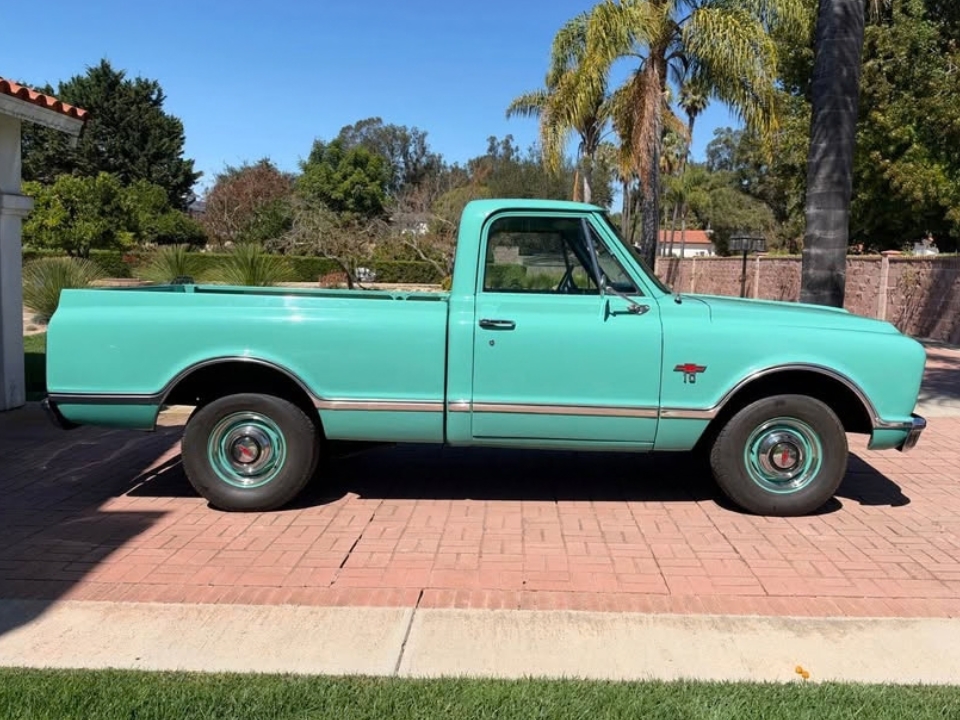
Let’s start with that color. The light turquoise is pure 1960s Southern California. It’s the kind of shade that belongs parked in front of a stucco ranch house with a citrus tree in the yard, which is roughly where the seller photographed it. I’d love to know whether this was the truck’s original hue, so a peek at the cowl tag should be on any buyer’s list. Either way, it suits the truck far better than another round of black or Lexus pearl white.
The seller calls the body “laser straight,” and the broadside photo does a decent job of backing that up. The reflections run clean down the cab and bed sides, and the door gaps look even. Sharp-eyed readers will notice there are no side marker lamps on the front fenders. That’s a 1967-only trait, since federal rules added them for 1968. The lower stainless spears, chrome front bumper, and bowtie fender emblems all look crisp. I really like the wheel choice. Painted steelies with dog-dish caps and color-keyed rings give the truck a period-correct look that no set of billet rims could match.
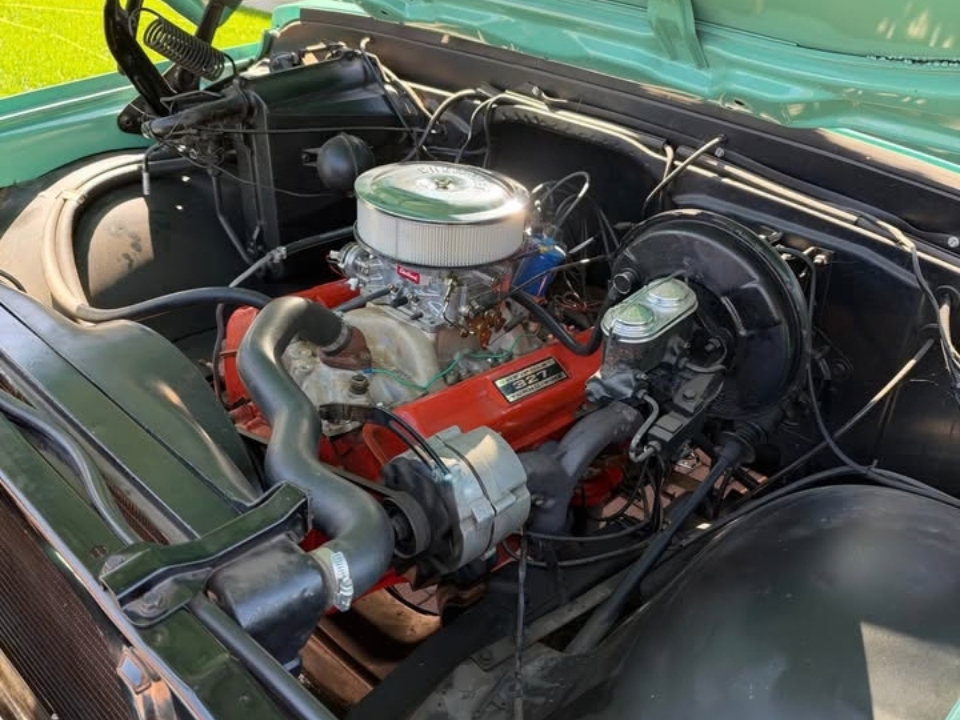
It isn’t flawless, and it shouldn’t pretend to be. In the engine bay shot, a dark line runs along the underside edge of the hood. It could be seam sealer, or it could be a stress crack in the inner structure, and I’d want to see it up close. The listing also doesn’t show the cab corners, rockers, or floor pans from underneath. As always with a fresh restoration, it’s worth asking for photos taken before the paint went on, so you know what’s under all that turquoise.
Inside the Cab
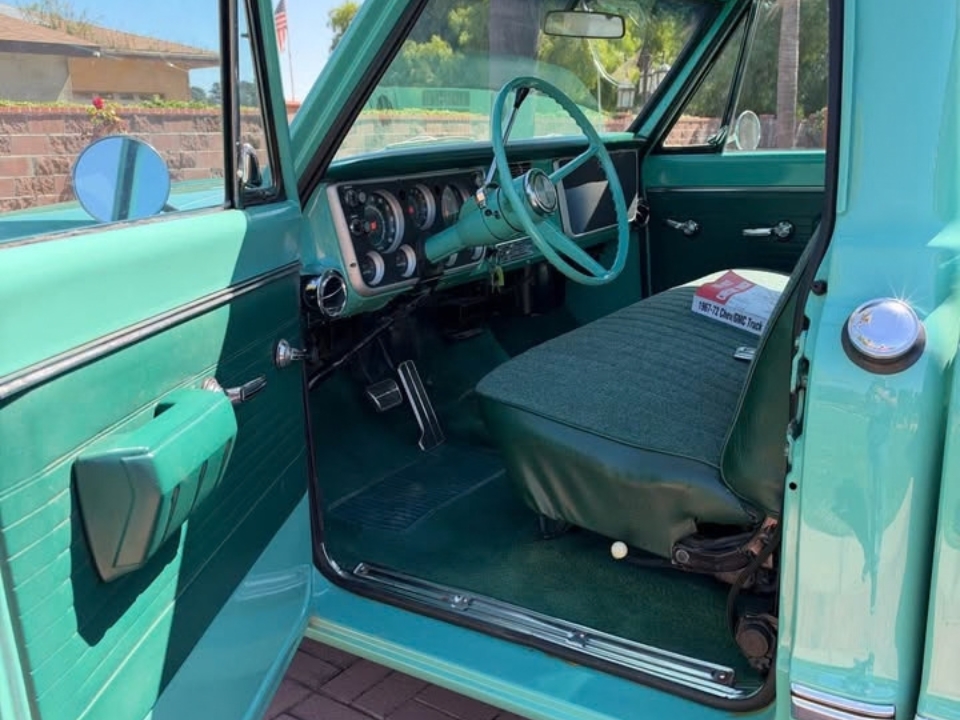
Open the door and the theme carries right through. The painted dash, steering wheel, and door panels match the exterior, and the panels use ribbed inserts and chrome-trimmed armrests. The bench is dressed in deep green vinyl with a patterned insert, and it sits on matching green carpet. It’s a monochrome look that could go wrong, but here it reads as cohesive and period-appropriate rather than cartoonish.
The gauge cluster looks sharp and may well be an upgraded unit, so it’s worth asking what’s behind the glass. The more important detail is the round vent beside the steering column, which is part of the factory air conditioning I’ll get to in a moment. In a charming touch, the seller left a well-thumbed 1967–72 Chevy/GMC truck restoration guide sitting on the seat, which tells you something about how this truck was approached. The seat tracks and hardware under the bench are a bit grubby compared to everything else. That’s an afternoon with a wire brush, not a dealbreaker.
Under the Hood and Behind the Wheel
This is a really nice example of a 1967–72 Chevrolet C10 2WD truck, and the details that matter most to me aren’t the ones that photograph best. Start with the bed. It’s a factory short bed, not a long bed that someone cut down to chase the look. That distinction matters more every year. Converted trucks are everywhere, and the quality of those frame and bed surgeries ranges from professional to terrifying. A genuine 115-inch-wheelbase truck simply doesn’t carry that baggage, so a buyer should still check the frame behind the cab for splice welds just to confirm.
Then there’s the air conditioning. Having factory A/C already routed through the original sheetmetal dash is a huge bonus. Anyone who has retrofit an aftermarket system knows the pain of cutting, drilling, and fudging vents into a dash that was never designed for them. Here, the ductwork and outlets are already where Chevrolet put them. The catch is that the compressor and condenser are missing, so the system won’t blow cold until those are sourced. Most owners would modernize the refrigerant side while they’re at it. Still, the hard part is already done.
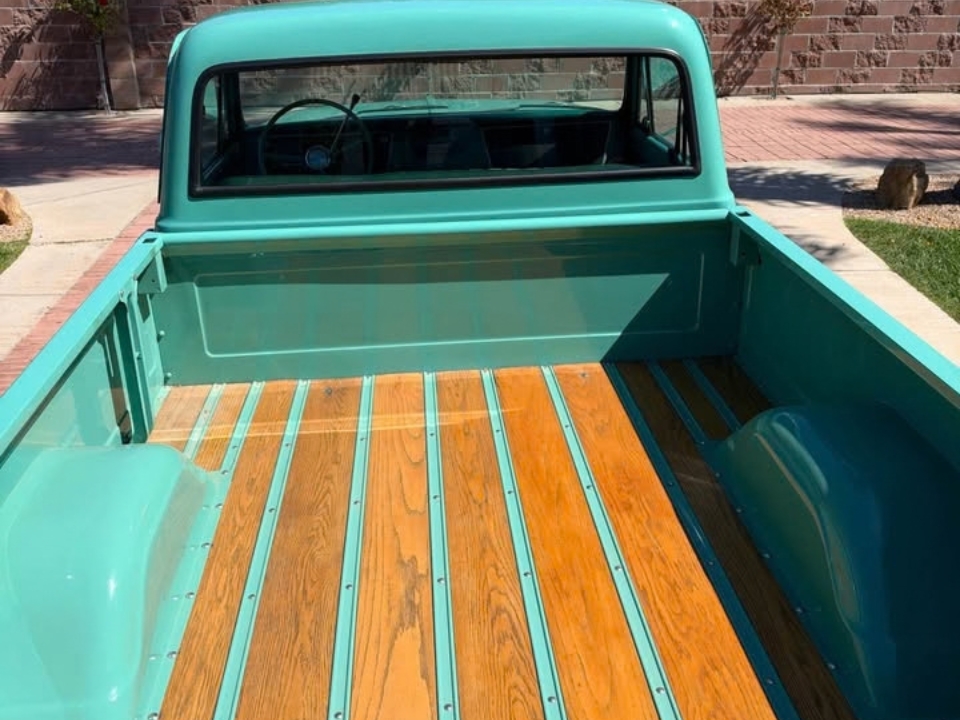
The wood bed floor is the cherry on top, and it’s rare to find one in great shape. Most original wood floors rotted away decades ago or got buried under a bedliner. These boards glow with a warm amber finish between turquoise strips, and the smooth wheel tubs on either side make it look almost too nice to haul anything in.
Power comes from a 327 small-block, dressed in Chevy orange with a chrome open-element air cleaner perched on an Edelbrock four-barrel. A power brake booster and a dual master cylinder add stopping confidence. Behind it sits a Turbo 350 automatic. That transmission wasn’t offered in 1967, so it’s a later swap, and a welcome one compared to the two-speed Powerglide. Turn the key and you can practically hear the result: the starter grinds briefly, the Edelbrock gulps, and the 327 settles into a lumpy, eager idle that rumbles through the floor. Pull the column shifter down into Drive with a mechanical clunk, and the truck squats ever so slightly before rolling out.
On the road, the coil-sprung rear soaks up expansion joints in a way leaf-sprung pickups of the era never could. The big, thin-rimmed wheel turns the recirculating-ball steering box with that unhurried, slightly loose on-center feel that every vintage truck owner learns to love. You make small corrections rather than precise inputs, and you let the truck wander a touch while the small-block hums along. It isn’t fast by modern standards, and it doesn’t need to be. Windows down on Highway 1 with that V8 burbling out back, this is exactly what an old Chevy truck should feel like.
Final Thoughts
At $39,500, this truck isn’t cheap, but you aren’t paying for a pile of question marks either. A factory short bed, a dash already set up for air, a well-kept wood floor, and a straight body add up to a truck you could enjoy right away while you chip away at the A/C. Would you finish the factory air system and keep it stock-appearing, or is this truck begging for a few tasteful upgrades? Let us know in the comments below!